The Packet Was Already Late Before My Application Saw It
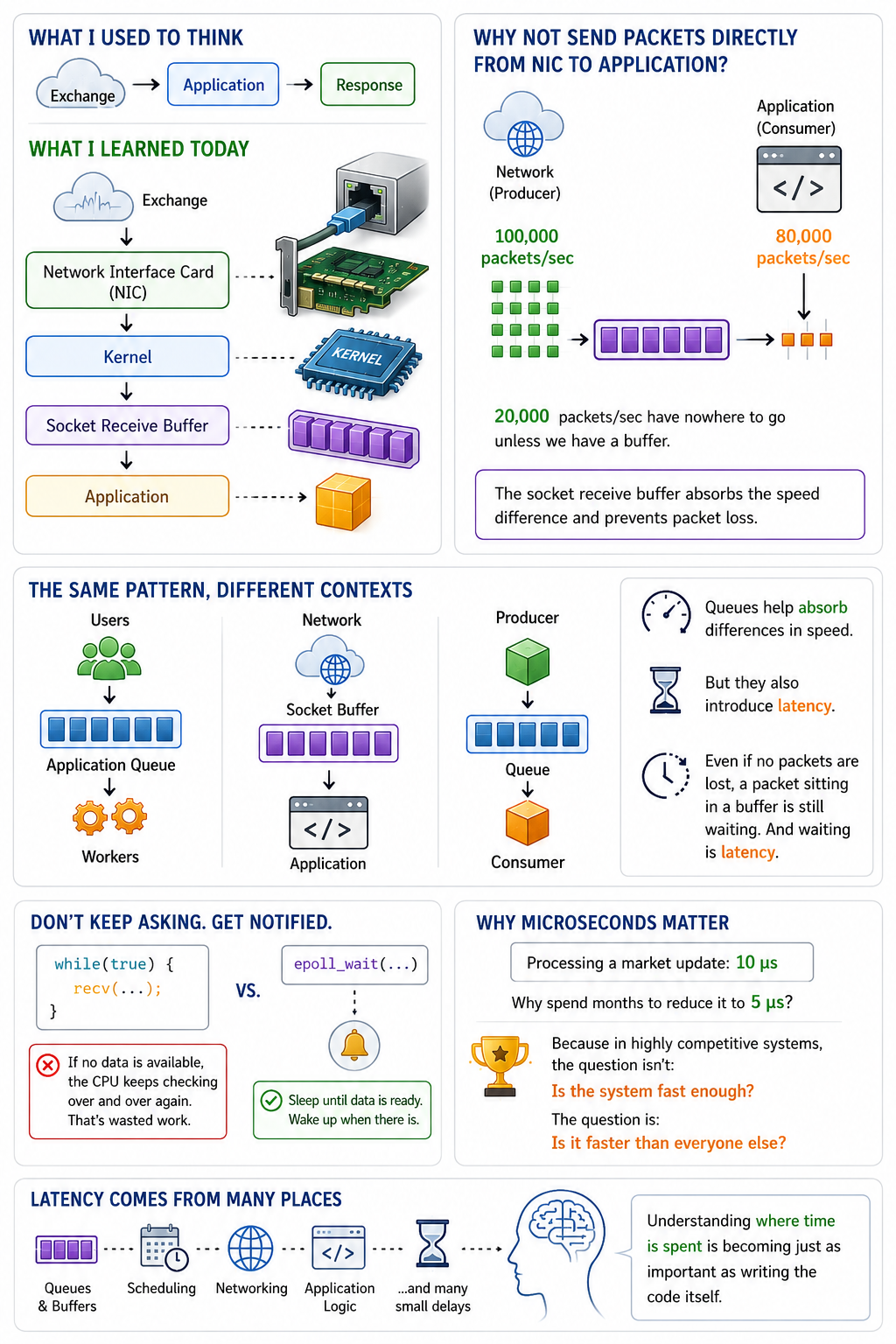
When we talk about performance, it's easy to think only about application code.
I used to imagine something like:
Exchange → Application → Response
But today I learned that reality is much more complicated.
A packet doesn't arrive directly in our application.
Instead, it follows a path like this:
Exchange
↓
Network Interface Card (NIC)
↓
Kernel
↓
Socket Receive Buffer
↓
Application
That raised an interesting question:
Why doesn't the operating system send packets directly from the network card to the application?
At first, I thought about protocol handling.
The kernel provides common networking functionality such as TCP/IP processing, flow control, validation, and other low-level operations that every application would otherwise need to implement itself.
But there is a more important reason.
Applications and networks operate at different speeds.
Imagine:
Packets arriving at 100,000 per second
Application processing only 80,000 per second
The extra 20,000 packets per second need somewhere to wait.
That's where the socket receive buffer comes in.
It acts as a temporary holding area between the network and the application.
Without it, packets would be dropped immediately whenever the application couldn't keep up.
What surprised me is how similar this is to the queueing problems I studied earlier.
Whether it's:
Users
↓
Application Queue
↓
Workers
or
Network
↓
Socket Buffer
↓
Application
the pattern is the same:
Producer
↓
Queue
↓
Consumer
Queues help absorb differences in speed.
But they also introduce latency.
Even if no packets are lost, a packet sitting in a buffer is still waiting.
And waiting is latency.
Another thing I learned is why high-performance servers don't continuously check every connection for new data.
A loop like this:
while(true) {
    recv(...);
}
looks simple, but if no data is available, the CPU keeps checking over and over again.
That's just wasted work.
Instead, mechanisms like epoll allow applications to sleep until data is actually ready.
Rather than asking:
"Is there data now?"
thousands of times per second, the application can simply say:
"Wake me up when there is."
The biggest realization from today came when thinking about high-frequency trading systems.
Suppose processing a market update takes only 10 microseconds.
Why would engineers spend months trying to reduce that to 5 microseconds?
Because in highly competitive systems, the question isn't:
Is the system fast enough?
The question is:
Is it faster than everyone else?
Sometimes a tiny improvement doesn't matter because it's absolutely faster.
It matters because it is relatively faster than the competition.
Today's lesson reinforced something I've been noticing throughout this journey:
Latency isn't a single problem.
It can come from queues, buffers, scheduling, networking, application logic, or countless small delays that accumulate throughout a system.
Understanding where time is spent is becoming just as important as writing the code itself.
Related Reading
Designing the Binary Wire Protocol for a C++ Limit Order Book Matching Engine
Designed a zero-parsing, cache-aligned binary wire protocol for a C++ matching engine with deterministic byte-offset message layouts
Single Threaded epoll Matching Engine in C++ for Deterministic Order Execution
How one CPU thread and Linux epoll enforce price and time priority in a C++ limit order book, with zero locks and zero heap allocation on the matching path